Searching for truth will hold you back
The sooner you stop, the better for you

Before we actually talk about strategies and techniques I’ve learned to use to influence reality, I want to address something important. Something that limited and misled me in the this quest.
Now, in the 21st century, after millennia of human ingenuity, inquisitiveness, and intellect, we’ve managed to map how most of reality works. We know for instance that the universe began with the Big Bang, and is about 13.8 billion years old. That matter is made of atoms, which are then made of protons/neutrons/electrons. That there are four fundamental forces, that energy and matter are somewhat interchangeable (E=mcˆ2), that the universe is expanding and accelerating, that time flows in one direction, that cause precedes effect, that space and time are woven together as spacetime, etc etc etc.
There is nothing new to be discovered in physics now. All that remains is more and more precise measurement.
— Lord Kelvin, 19000
We have already discovered the basic laws that govern matter and understand all the normal situations.
— Stephen Hawking, 2000
All we need to account for everything we see in our everyday lives are a handful of particles — electrons, protons, and neutrons — interacting via a few forces — the nuclear forces, gravity, and electromagnetism — subject to the basic rules of quantum mechanics and general relativity.
— Sean Carroll, 2010
We now understand how the universe arose from literally nothing.
— Lawrence Krauss, 2012
So, the thing I want to address in this post is that all these statements are very likely to be false.
I’m not saying that these aren’t useful theories about reality. Most of these absolutely are. Thanks to these and many more we managed to cure diseases, fly airplanes, and go to the moon.
But useful is not the same thing as true. And although scientific theories are often miscommunicated as true statements about reality, we have very little evidence (if any) to say that any of these claims describe the real nature of the universe.
Thinking that our best theories describe any objective part of the nature of reality is a philosophical view called wishful thinking scientific realism. I believe that this type of realism — although widely disseminated and accepted — is both unfounded and misleading for our quest to be better at influencing reality.
Here’s why.
1. Thin slices
Of all the available information in the universe, the only thing humans have been able to perceive at all are the things that our sensory systems evolved to pick up on. This might seem a lot to a human, but the more we develop new measurement devices and theories the more we see that it is actually a very thin slice of all that there is.
Take vision, for instance. Our sensory systems can perceive electromagnetic (EM) waves in the world. Amazingly cool, right? But also well, very local, and narrow. First of all, you can only see things that actually go through your visual system. Can’t see EM waves going through Saturn right now, obviously. Besides that, humans have about 210 degrees of visual field, out of which only about 6 degrees are actual clear vision. And mind you, our eyes can’t perceive any EM wave. We can only see constituent frequencies of around 400-800 THz. Any other frequency is simply invisible to us.
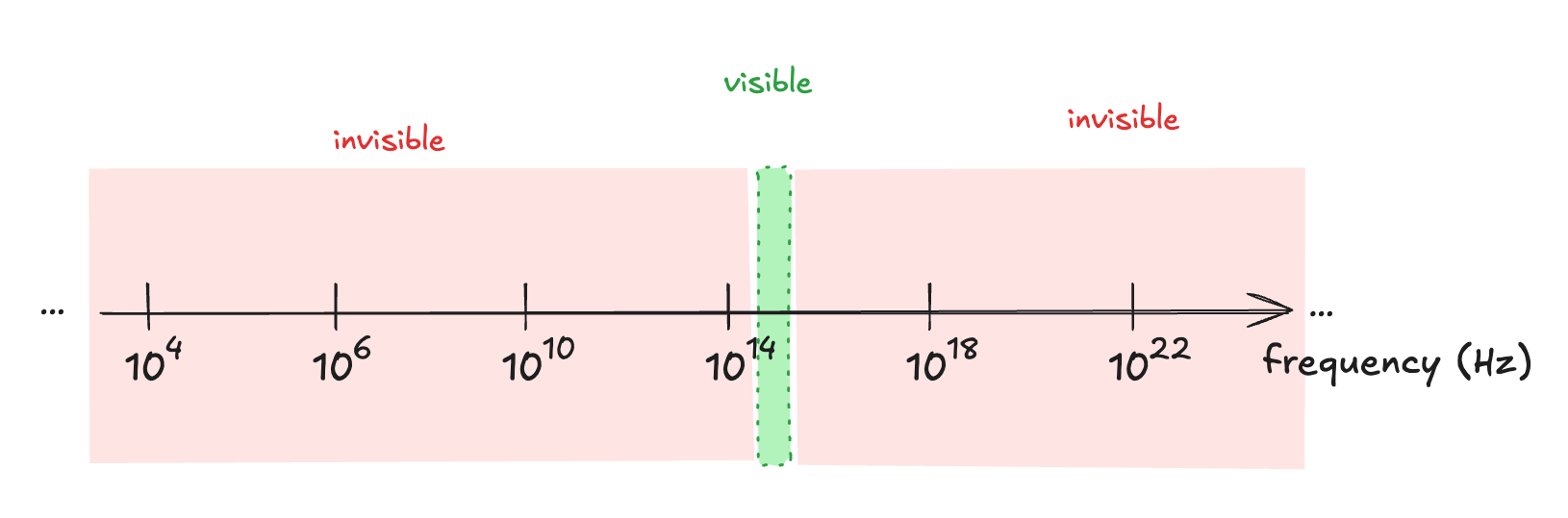
Oh, and waves can have multiple frequencies at once, but we only have three classes of cone cells in our eyes, so all the frequencies in a general EM wave are mapped down to a 3-dimensionsional space by our visual system1.
So, out of all of EM waves in the universe, our visual system sees only the ones that actually go through our eyes, with about 6 degrees of clear visual field, only of certain frequencies, and by mapping most of the complexity to a lower-dimensional space.
And this is the argument for vision, but you can do the same analysis for all our senses and will get to a very similar conclusion: we only experience a very thin slice of reality.
And this thin slice of reality that our senses managed to capture is estimated to be in the order of 11 million bits per second, from which our conscious mind seems to only be able to process around 50 bits per second. That’s a 200k times compression!
This is an image of a tree.

This is the same image, compressed by 200 thousand times.

Hopefully you got the point.
All these arguments are about how little of reality we can sense, among the things in reality we know exist. There might be (and to me seems more plausible than not) an enormous amount of reality which is completely invisible to us, and to all the measurement devices we created so far. We can’t sense it, measure it (at least for now), and we don’t even know it exists.
Although it seems like we’re actually sensing all of reality, it’s more like we’re stumbling in a dark football field with a really small and weak flashlight. Oh, and the flashlight can only light up green things, everything else stays dark.
2. Mind games
It gets worse. Not only are our senses only able to capture a very thin slice of reality at any given time, they’re probably not even trying to capture reality.
I like this intro from The Interface Theory of Perception from Donald Hoffman:
A goal of perception is to estimate true properties of the world. A goal of categorization is to classify its structure. Aeons of evolution have shaped our senses to this end. These three assumptions motivate much work on human perception. I here argue, on evolutionary grounds, that all three are false.
In it, Hoffman makes the argument that according to our current best theory of evolution, it seems unlikely that our senses evolved to recover or estimate any objective properties of reality. Instead, they evolved useful fictions for us to use as interfaces to reality.
If you think about it, it does make some intuitive sense. There’s no direct evolutionary pressure for our senses to reconstruct reality faithfully. The utmost goal is for our genes to reproduce. Why would you need senses that actually reconstruct reality? That sounds way too costly to maintain. It seems much more natural that we just evolved to see whatever we need to see in order to survive and reproduce.
If there was ever a mutation that makes you see something that is absolutely not in reality, but made you more likely to survive long enough to reproduce2 , natural selection wouldn’t be like “oh wait hold on, this species is losing touch with reality, let’s backtrack a bit”. No, fitness beats truth. “Let the species hallucinate, if it makes them fitter”3.
3. Underdetermination
But hey, at least we have the scientific method, right? That surely can lead us to theories which describe the universe better and better, maybe eventually being able to actually make statements about what the universe really is like.
Well, not really. It might, but it might not.
We do have a lot of anecdotal evidence that following the scientific method4 results in theories that predict reality more and more accurately over time. But as far as I know5, there’s no reason to believe that that will always be the case. There doesn’t seem to be any compelling proof that the scientific method will give us more and more accurate theories over time.
But put that aside for a second. Let’s imagine it does. Let’s imagine that we, for some reason, have been lucky enough to be in this huge football field, with our flimsy flashlight, and stumbled upon a method that actually allows us to create theories about the football field with arbitrary precision. Want a more accurate theory? Just follow the method for a few more decades and you get one.
Even in this scenario, we might not be able to make any statements about the nature of reality.
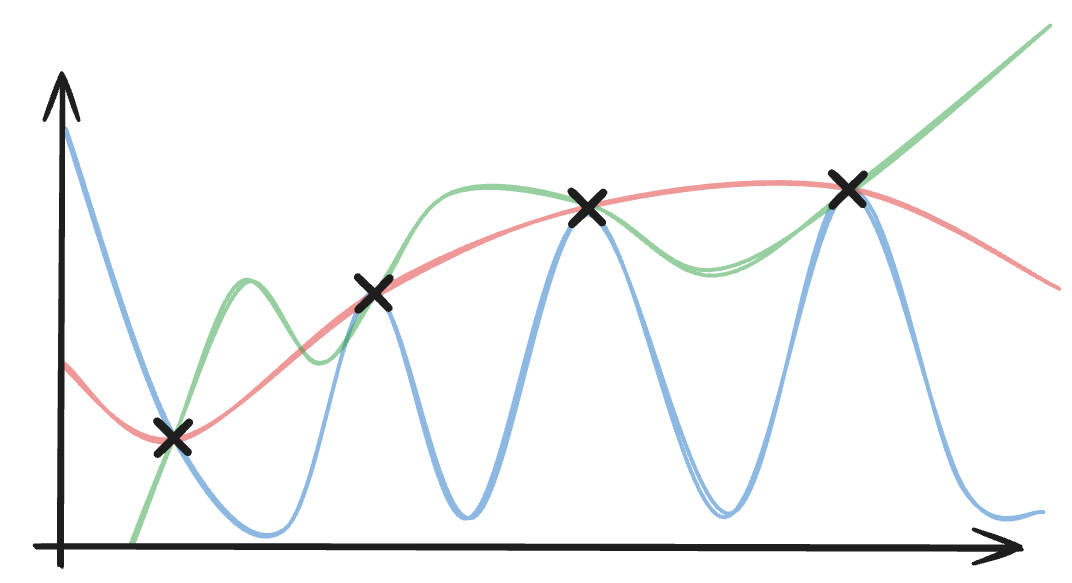
And the problem here is underdetermination. It might just be that the parts of the universe that we can observe (via our senses and all the types of measurement devices we end up creating) do not fully constrain what the universe can be.
That is, it might very well be that 3 different versions of the universe could generate exactly the same data that we’ve been observing.
If that’s the case, even if we get a perfect-fit theory — one that can perfectly predict all of reality— we still wouldn’t be able to say that’s what reality truly is. Because how would we know that our methods converged to the right theory among the 3 that describe reality perfectly?6
So, even though:
Our senses only experience a *very* thin slice of reality
Our brain hallucinates much of our experience
Reality might be underdetermined by our observations
It’s reasonable to believe that our current best theories actually describe reality?
To me this seems like an indefensible position.
Harmful fiction
Here’s the kicker. The problem is not only that we don’t seem to have any reason to believe in scientific realism. There’s another issue, disconnected from whether it is true or not:
Realism will hinder your ability to influence reality.
It creates too strong of an incentive to optimize models for accuracy, rather than usefulness (often even conflating these two), which causes a myriad of problems for aspiring reality-influencers.
First of all, it makes you more passive. If the goal is accuracy/truth, how can you possibly compete with experts? Some of our current best models of the universe have unimaginable accuracy. You would unconsciously think “let the experts do all the model-building, this is not something for us mere mortals.” Which brings also an overconfidence problem along the lines of “if the best experts in the world came up with this theory, this must really be how the world works.”
Second, even if you do try building your own models, realism will make you undervalue the simple ones. You have internalized that a good model is accurate, comprehensive, detailed. Rough heuristics like “people get defensive when they feel judged” are too coarse to be taken seriously, and so you dismiss it. A real description surely involves neurotransmitters and evolutionary psychology.
Lastly, realism makes you dismiss entire domains of useful information. If you can’t measure something, reduce it to simple-enough mechanisms to be understood, and model it with clean mathematical language, then that phenomenon immediately becomes suspect. This makes people ignore their emotional responses, intuitions, subtle dynamics in relationships, etc. All the messy, hard-to-formalize aspects of reality — regardless of how important they might be for achieving your goals — aren’t really real7.
Realism promises to point you towards truth, but I think that in practice it leaves you less capable of navigating reality, not more.
And this is the big irony. By giving up our quest for truth, we get more traction on reality. We’re no longer paralyzed by having to always hit the mark on what’s actually true. Truth only matters when it has instrumental value towards usefulness. We’re free to build, test, and refine models towards making them useful for influencing reality.
Let’s say I give you two models. One represents 95% of reality faithfully. It’s super comprehensive, validated by all experts in the world, and mega accurate. The other is complete bogus, woo-woo hallucinations that get reality almost entirely wrong. But makes you consistently able to influence reality towards the goal states that matter for your life.
Which would you choose?
Hence, metamerism.
Including the energy expenditure to create the hallucination.
For example, our visual system seems to hallucinate many parts of our experience.
Whatever that means…
And I would be happy if anyone proved me wrong here.
Hopefully by now we share the irony when a realist tells you something isn’t real.